EDT vs EDP vs EDC vs Parfum vs Extrait: Complete Fragrance Guide 2026
Walk into a perfume store and you may see several bottles carrying similar names but very different labels:
EDC. EDT. EDP. Parfum. Extrait de Parfum.
Sometimes you may even come across the much rarer term Esprit de Parfum.
What do all of these actually mean?
The short answer is that these terms generally indicate the concentration and style of a fragrance, but the subject is more complicated than simply saying that a higher percentage automatically means a stronger or better perfume.
An Eau de Toilette can sometimes project more noticeably than an Eau de Parfum. An Extrait de Parfum may last longer but sit closer to the skin. And the EDP version of a fragrance may smell noticeably different from its EDT rather than simply being a stronger version of exactly the same formula.
This guide explains the differences between Eau de Cologne, Eau de Toilette, Eau de Parfum, Parfum, Extrait de Parfum and Esprit de Parfum, and helps you decide which concentration may suit your lifestyle, budget and the UAE climate.
What Does Perfume Concentration Mean?
Perfume is generally made using aromatic materials combined with a carrier, commonly alcohol and water.
When people talk about fragrance concentration, they are referring to the approximate proportion of aromatic materials contained in the finished fragrance.
In simple terms:
More fragrance concentrate + less carrier = generally higher concentration
However, fragrance terminology is not governed by one universal percentage system used identically by every perfume brand.
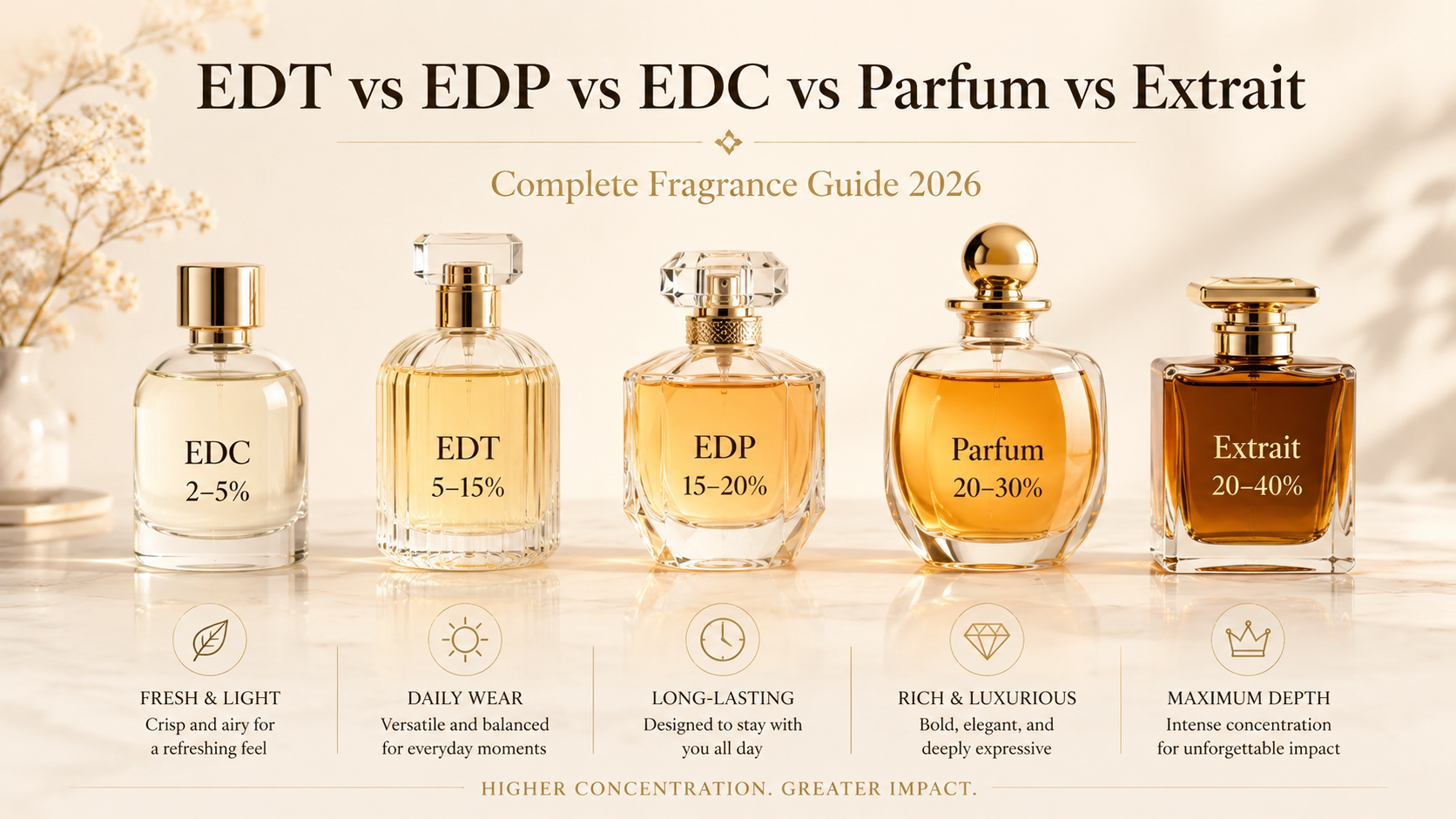
For example, Dubai Municipality's fragrance-product guidance gives general ranges of 15–20% for Eau de Parfum, 5–15% for Eau de Toilette and 2–4% for Cologne. Broader perfumery references often place Parfum/Extrait around 15–40% and the rare Esprit de Parfum around 15–30%. These should therefore be treated as useful ranges rather than fixed rules for every bottle.
Perfume Concentrations at a Glance
Type
Common Abbreviation
Typical Concentration*
General Character
Eau de Cologne
EDC
Around 2–5%
Light, fresh, refreshing
Eau de Toilette
EDT
Around 5–15%
Fresh, noticeable, versatile
Eau de Parfum
EDP
Around 15–20%
Richer, fuller, often longer wearing
Esprit de Parfum
ESdP
Around 15–30%
Rare concentration between EDP and Parfum
Parfum
Parfum
Often around 20%+
Rich, concentrated, smooth
Extrait de Parfum
Extrait
Often around 20–40%
Highly concentrated, deep, luxurious
*These percentages are approximate industry ranges rather than universal legal definitions. Different brands and formulas can fall outside them.
What Is Eau de Cologne – EDC?
Eau de Cologne, usually abbreviated as EDC, is traditionally one of the lighter fragrance concentrations.
Dubai Municipality describes Cologne as generally containing around 2–4% fragrance concentration, while other perfumery references sometimes use slightly broader ranges.
What Does EDC Feel Like?
Eau de Cologne fragrances often emphasize:
Citrus
Herbs
Aromatic notes
Light florals
Fresh spices
They are generally designed to feel refreshing rather than extremely dense or long-lasting.
When Is Eau de Cologne Best?
EDC can be particularly useful for:
Hot weather
Daytime use
After-shower fragrance
Casual occasions
Frequent reapplication
People who dislike strong perfumes
Is Eau de Cologne Only for Men?
No.
The word “cologne” is often used casually—particularly in some markets—to mean men's fragrance.
But technically, Eau de Cologne refers to a fragrance style/concentration, not a gender.
Women can wear Eau de Cologne, and men can wear Eau de Parfum, Parfum or Extrait.
What Is Eau de Toilette – EDT?
Eau de Toilette, or EDT, is one of the most common fragrance concentrations.
Dubai Municipality gives a general concentration range of 5–15% for Eau de Toilette.
EDT fragrances frequently feel brighter and more open than heavier concentrations.
What Does EDT Usually Smell Like?
An EDT may emphasize:
Citrus
Aromatic herbs
Fresh spices
Aquatic notes
Green notes
Lighter woods
This does not mean every EDT is fresh. There are sweet, woody, spicy and oriental Eau de Toilettes as well.
How Long Does EDT Last?
There is no guaranteed number.
A typical EDT may provide several hours of noticeable fragrance, but actual longevity depends on:
Formula
Ingredients
Skin type
Climate
Number of sprays
Application area
Humidity
Some Eau de Toilettes can outperform Eau de Parfums in real-world wear.
Who Should Choose EDT?
EDT can be an excellent choice if you prefer:
Noticeable freshness
Moderate intensity
Daytime fragrance
Office-friendly scents
Warm-weather perfumes
Something easier to reapply
What Is Eau de Parfum – EDP?
Eau de Parfum, usually abbreviated as EDP, has become one of the most popular formats in modern perfumery.
Dubai Municipality's fragrance guidance describes Eau de Parfum as generally containing approximately 15–20% fragrance concentration.
What Does EDP Mean for the Scent?
Compared with an EDT from the same fragrance family, an EDP may feel:
Richer
Deeper
Smoother
Warmer
More concentrated
More persistent
But this is not guaranteed.
An EDP can also use an altered fragrance formula.
For example, a brand may make its EDT brighter and more citrus-focused while giving the EDP additional vanilla, amber, woods or spices.
Therefore:
EDP does not always mean “the EDT with more perfume oil.”
It can be a different interpretation of the same fragrance idea.
EDT vs EDP: What Is the Difference?
This is probably the most common perfume concentration question.
EDT
Usually:
Lighter concentration
Brighter opening
Fresher impression
Often stronger initial diffusion
Good for daytime
Often suitable for warmer weather
EDP
Usually:
Higher concentration
Fuller body
Greater depth
Often stronger dry-down
Frequently better persistence
Good for day-to-evening use
But the important word here is usually.
Formula matters enormously.
Does EDP Last Longer Than EDT?
Often—but not always.
A higher concentration can contribute to longevity, but it is only one factor.
Consider two hypothetical fragrances:
Fragrance A EDT: strong woody-musky materials with excellent persistence.
Fragrance B EDP: delicate citrus and natural floral materials that evaporate more quickly.
Despite the labels, Fragrance A might remain noticeable longer.
This is why concentration should be treated as one clue about performance, not a guarantee.
Can EDT Project More Than EDP?
Yes.
This surprises many fragrance buyers.
More alcohol in a lighter fragrance can sometimes help volatile aromatic molecules diffuse quickly, producing a noticeable opening and scent trail.
A richer Parfum or Extrait may evaporate more slowly and remain closer to the skin.
So:
Higher concentration does not automatically mean bigger projection.
Sometimes it means greater density and longer persistence instead.
What Is Parfum?
Parfum, sometimes referred to simply as perfume, represents one of the higher fragrance concentrations.
Broad perfumery references commonly place Parfum within a wide 15–40% aromatic-compound range, although individual brands can formulate differently.
What Does Parfum Usually Feel Like?
Parfum versions often feel:
Rich
Smooth
Concentrated
Deep
Refined
Less sharp in the opening
Because there may be relatively less alcohol compared with lighter formats, the fragrance can sometimes develop more slowly.
Is Parfum Stronger Than EDP?
In concentration terms, generally yes.
But again, “stronger” can mean different things.
Parfum might give you:
Longer persistence
Greater richness
More depth
while an EDP or EDT might produce:
Stronger initial projection
Brighter opening
Larger early scent cloud
The experience depends on the fragrance.
What Is Extrait de Parfum?
Extrait de Parfum is generally associated with some of the highest concentrations used in fine fragrance.
You may also see terms such as:
Perfume Extract
Extrait
Pure Parfum
Parfum Extrait
Traditional industry references commonly place Parfum/Extrait somewhere within a broad range reaching approximately 40% aromatic material, depending on the formulation.
Parfum vs Extrait de Parfum: Are They the Same?
Sometimes they are effectively used as equivalent terms.
Other times, brands use Extrait de Parfum to identify a particularly concentrated or richer version within a collection.
There is no universal rule requiring every company to use Parfum and Extrait in exactly the same way.
When comparing two bottles, it is therefore better to look at:
Brand description
Actual formulation
Notes
Performance
Reviews
Your own skin test
rather than relying only on the concentration name.
What Does Extrait de Parfum Smell Like?
Extraits often emphasize deeper aspects of a composition.
Common characteristics may include:
Rich woods
Amber
Vanilla
Resins
Musk
Oud
Leather
Spices
Dense florals
But an Extrait can also be fresh, citrusy or aromatic.
The concentration describes the format—not the fragrance family.
Does Extrait de Parfum Last Longer?
It often has the potential for excellent longevity because of its higher concentration.
However, it still depends on the materials used.
An Extrait should not automatically be expected to last a fixed 12, 18 or 24 hours simply because of the label.
Perfume performance claims should always be considered approximate.
Does Extrait Project More?
Not necessarily.
This is one of the biggest misunderstandings about perfume concentration.
An Extrait can sometimes create a smaller but more persistent scent bubble.
An EDT may feel much louder during its first hour but disappear earlier.
Think of it like this:
EDT = potentially brighter and more expansive
Extrait = potentially denser and more persistent
That is an oversimplification, but it is often more useful than assuming the strongest concentration must create the biggest scent trail.
What Is Esprit de Parfum?
Esprit de Parfum is a rare and largely historical perfume-concentration term.
You may occasionally see it incorrectly referred to in English as “Spirit de Parfum.”
The established French terminology is Esprit de Parfum.
Historical fragrance references place Esprit de Parfum somewhere between Eau de Parfum and traditional Parfum, often quoting a broad concentration of approximately 15–30%. It was used on some older fragrances, including historical Dior releases, but is rarely seen in mainstream modern perfume ranges.
Is Esprit de Parfum Stronger Than EDP?
Historically, it was generally positioned above standard Eau de Parfum.
A simplified order would be:
EDC → EDT → EDP → Esprit de Parfum → Parfum/Extrait
However, the ranges overlap considerably.
Because Esprit de Parfum is not a standardized modern category, it should not be treated as a precise concentration measurement.
EDC vs EDT vs EDP vs Parfum vs Extrait
Here is the simplest way to understand the family.
Eau de Cologne
Best if: You want something very light and refreshing.
Eau de Toilette
Best if: You want freshness, versatility and noticeable projection without excessive richness.
Eau de Parfum
Best if: You want a balance between projection, richness and longevity.
Parfum
Best if: You want something richer, smoother and generally more concentrated.
Extrait de Parfum
Best if: You enjoy highly concentrated fragrances with depth and potentially excellent longevity.
Esprit de Parfum
Best understood as: A rare historical concentration term generally positioned between EDP and Parfum.
Which Perfume Concentration Lasts the Longest?
In a very general concentration hierarchy:
Extrait/Parfum → EDP → EDT → EDC
But real fragrance performance does not always follow that sequence.
Longevity Depends on the Ingredients
Long-lasting materials can include:
Oud
Patchouli
Amber-style materials
Musk
Vanilla
Leather accords
Woods
Resins
More volatile materials can include:
Lemon
Bergamot
Grapefruit
Some herbs
Light aromatic notes
That is why a woody EDP may remain noticeable much longer than a citrus-heavy fragrance at a similar concentration.
What Is Sillage?
Sillage refers to the scent trail a fragrance leaves behind as you move.
Imagine walking through a room and someone noticing your fragrance a few seconds later.
That trail is sillage.
Higher concentration does not automatically create stronger sillage.
Some EDT fragrances create enormous scent trails because of the materials used, while some Extraits remain relatively intimate.
What Is Projection?
Projection describes how far the fragrance radiates from your skin.
For example:
Close Projection
The fragrance is mostly noticeable when someone is near you.
Moderate Projection
It creates a noticeable personal scent bubble.
Strong Projection
The fragrance can be detected from further away.
Projection is often strongest shortly after application and gradually decreases as the fragrance develops.
Longevity vs Projection vs Sillage
These terms are related but different.
Longevity: How long the fragrance remains detectable.
Projection: How far it radiates from your body.
Sillage: The trail it leaves behind.
A perfume can have:
Excellent longevity + moderate projection
or
Huge projection + shorter longevity.
This distinction is especially important when comparing EDT, EDP and Extrait.
Does Higher Perfume Concentration Mean Better Quality?
No.
This is another common misconception.
Higher concentration generally means a larger proportion of aromatic material, but it does not automatically tell you:
Ingredient quality
Creativity
Complexity
Balance
Performance
Whether you will enjoy the scent
A beautifully constructed Eau de Toilette can be a better fragrance for you than an expensive Extrait de Parfum.
Choose perfume based on the complete experience, not the concentration number alone.
Why Does the EDT Smell Different From the EDP?
Because perfume houses frequently reformulate the scent profile for each concentration.
For example, imagine a fictional perfume available in three versions.
EDT
Bergamot → Lavender → Cedar
EDP
Bergamot → Lavender → Amber → Vanilla
Parfum
Lavender → Vanilla → Amber → Sandalwood
They may share the same fragrance identity while producing noticeably different experiences.
This is why you should test each concentration rather than assuming you already know the EDP because you have smelled the EDT.
Which Concentration Is Best for Dubai and UAE Weather?
The UAE climate makes concentration particularly interesting.
High temperatures can increase fragrance diffusion, meaning rich perfumes may feel significantly stronger outdoors.
Best for Hot UAE Daytime
Consider:
EDC
EDT
Fresh EDPs
Citrus fragrances
Aromatic fragrances
Fresh woody perfumes
These can feel more comfortable during high daytime temperatures.
That does not mean you cannot wear Parfum or Extrait in summer.
It simply means application should be adjusted.
Best for UAE Evenings
During evenings or inside air-conditioned environments, richer concentrations can become easier to wear.
Consider:
EDP
Parfum
Extrait de Parfum
Amber fragrances
Oud perfumes
Gourmand perfumes
Woody fragrances
Restaurants, hotels, malls, events and evening occasions allow richer perfume styles to develop differently compared with direct outdoor heat.
Should You Spray Less Perfume in Dubai Summer?
Usually, yes—particularly with dense fragrances.
Instead of changing your entire fragrance collection, try adjusting the application.
For example:
Cool evening: 4–6 sprays may feel comfortable for some fragrances.
Very hot daytime: 2–3 sprays of the same fragrance may be enough.
There is no universal correct spray count because perfumes vary enormously.
Which Concentration Is Best for Office Wear?
For many workplaces:
EDT or moderate EDP can be excellent choices.
The objective should be to smell pleasant without filling the entire office with fragrance.
However, concentration alone does not determine whether something is office-friendly.
A powerful oud EDT could be much stronger than a soft floral EDP.
Always consider the actual fragrance.
Which Concentration Is Best for Date Night?
EDP, Parfum and Extrait are popular options because richer concentrations often suit evening environments.
Popular date-night fragrance styles include:
Amber
Vanilla
Tonka bean
Woods
Musk
Spices
Gourmand notes
But a fresh EDT can also work beautifully, particularly during warm UAE evenings.
Which Concentration Is Best for Everyday Wear?
EDT and EDP are probably the most versatile options for most fragrance wardrobes.
Choose EDT if you prefer:
Freshness
Lighter character
Easy reapplication
Choose EDP if you prefer:
More depth
Richer dry-down
Potentially longer wear
Which Concentration Is Best for Special Occasions?
Parfum and Extrait de Parfum can feel particularly appropriate for:
Weddings
Formal dinners
Luxury events
Celebrations
Evening occasions
Special dates
Their richer character can make them feel more deliberate and luxurious.
But again, the actual fragrance matters more than the wording on the bottle.
Is Extrait de Parfum Worth the Higher Price?
It depends.
Extrait versions are often more expensive because of concentration, formulation, positioning and sometimes packaging.
An Extrait may be worthwhile if:
You love the fragrance
You prefer richer perfumes
You value longevity
You use fewer sprays
You prefer a more intimate scent
You want a premium fragrance experience
But don't automatically buy the Extrait because it sounds more luxurious.
Test the EDP and EDT as well.
You may actually prefer their scent profile.
How to Choose Between EDT and EDP Before Buying
Use this simple process.
Step 1: Smell Both
Don't judge solely from online descriptions.
Step 2: Test on Skin
Paper strips are useful for the opening, but your skin shows how the fragrance develops.
Step 3: Give the Fragrance Time
Do not decide within the first five minutes.
Wait for the dry-down.
Step 4: Compare Performance
Consider:
Opening
Projection
Dry-down
Longevity
Comfort
Versatility
Step 5: Consider Your Climate
A perfume worn in Dubai can behave very differently from the same fragrance worn in a cool European climate.
Step 6: Buy the Version You Actually Prefer
Do not automatically choose EDP because the percentage appears higher.
The best concentration is the one you enjoy wearing.
Common Perfume Concentration Myths
Myth 1: EDP Is Always Better Than EDT
False.
It is usually more concentrated, not automatically better.
Myth 2: Extrait Always Projects the Most
False.
It may actually sit closer to the skin.
Myth 3: EDT Is Weak
False.
Some EDTs are extremely powerful.
Myth 4: Cologne Means Men's Perfume
Not technically.
EDC refers primarily to a fragrance concentration/style.
Myth 5: More Expensive Means Longer Lasting
Not necessarily.
Price is influenced by branding, ingredients, packaging, distribution and positioning—not only performance.
Myth 6: Higher Concentration Means the Same Smell, Just Stronger
Frequently false.
Different concentrations may have noticeably different formulas.
Quick Guide: Which Concentration Should You Buy?
Choose EDC If:
You want something refreshing and very light.
Choose EDT If:
You want an easy-to-wear fragrance for everyday use and warmer weather.
Choose EDP If:
You want a versatile balance of richness, presence and potential longevity.
Choose Parfum If:
You prefer a deeper and more concentrated experience.
Choose Extrait de Parfum If:
You want maximum richness and enjoy highly concentrated fragrances.
Choose Esprit de Parfum If:
You encounter a vintage or unusual fragrance using this rare historical terminology and enjoy the composition itself.
Frequently Asked Questions About Perfume Concentrations
What does EDT mean in perfume?
EDT means Eau de Toilette.
It generally has a lighter fragrance concentration than Eau de Parfum and is commonly associated with fresh, versatile everyday wear.
What does EDP mean in perfume?
EDP means Eau de Parfum.
It generally contains a higher proportion of aromatic material than EDT and often provides a richer fragrance experience.
What does EDC mean?
EDC means Eau de Cologne.
It is generally a lighter fragrance concentration with a fresh and refreshing character.
What is the difference between EDT and EDP?
EDT is generally lighter and often fresher, while EDP usually contains a higher fragrance concentration and can feel richer or deeper.
However, the two versions may also use different formulas.
Is EDP stronger than EDT?
Usually in terms of concentration, yes.
But an EDT can sometimes project more strongly or even perform longer depending on its formulation.
What is Parfum?
Parfum is a highly concentrated fragrance format generally positioned above Eau de Parfum.
What is Extrait de Parfum?
Extrait de Parfum is one of the most concentrated forms of fine fragrance and is often associated with richer composition and strong persistence.
Is Parfum the same as Extrait de Parfum?
The terms can overlap and are sometimes used interchangeably, although some brands use Extrait to identify a distinct, more concentrated interpretation.
What is Spirit de Parfum?
The established historical term is generally Esprit de Parfum, not Spirit de Parfum.
It is a rare fragrance concentration traditionally positioned somewhere between Eau de Parfum and Parfum. Historical perfume references commonly associate it with approximately 15–30% aromatic compounds, although the terminology is not standardized.
Which lasts longer, EDT or EDP?
EDP often lasts longer, but this is not guaranteed.
The fragrance materials, formula, skin type and environment all affect longevity.
Which lasts longer, EDP or Extrait?
Extrait often has greater persistence because of its higher concentration, but the specific formula remains more important than the label alone.
What is the strongest perfume concentration?
Parfum and Extrait de Parfum are generally among the highest concentrations commonly sold in fine fragrance.
Which fragrance concentration is best for Dubai?
For hot daytime conditions, EDT or fresher EDP fragrances can be comfortable choices.
For evenings and air-conditioned environments, EDP, Parfum and Extrait can work particularly well.
The fragrance itself and the number of sprays matter just as much as concentration.
Is Eau de Toilette good for UAE summer?
Yes.
Fresh EDT fragrances can be excellent for hot weather, especially citrus, aromatic and woody compositions.
Is Extrait de Parfum good for summer?
It can be, but use it carefully.
A dense Extrait may become very noticeable in high UAE temperatures, so fewer sprays may be appropriate.
Where Can I Buy EDT, EDP, Parfum and Extrait de Parfum in Dubai, UAE?
Looking for authentic perfumes in Dubai and across the UAE?
Shop at BrandsPerfume.com and explore a wide range of fragrance concentrations, including:
Eau de Toilette
Eau de Parfum
Parfum
Extrait de Parfum
Men's fragrances
Women's perfumes
Unisex fragrances
Designer perfumes
Niche fragrances
Compare different fragrance styles and concentrations to find the perfume that best matches your personality, occasion and UAE lifestyle.
Final Thoughts: EDT, EDP or Extrait – Which Is Best?
There is no single concentration that is best for everyone.
If you prefer freshness and versatility, EDT may be ideal.
If you want a balance between depth, longevity and everyday wear, EDP is often an excellent choice.
If you prefer something richer and more concentrated, explore Parfum.
And if you enjoy a deep, luxurious and highly concentrated fragrance experience, Extrait de Parfum may be the right direction.
The most important thing to remember is this:
Concentration tells you something about a perfume—but it does not tell you everything.
Formula, ingredients, skin chemistry, temperature, projection and personal taste can all matter more than three letters printed on a bottle.
So when choosing between EDC, EDT, EDP, Parfum or Extrait, don't simply buy the highest concentration.
Choose the fragrance that smells best on you.